1. Introduction to Electro Contaminant Removal (ECR) Technology
In industrial wastewater treatment, especially for complex and hazardous wastewater streams, the effectiveness of downstream processes depends heavily on the quality of pre-treatment.
Electro Contaminant Removal (ECR) is an advanced electrochemical technology that uses electrical current to generate active species directly within the wastewater. These species enable the removal of contaminants through a combination of:
- Electrochemical reactions
- In-situ coagulant generation
- Oxidation processes
- Microbubble flotation
Unlike conventional chemical treatment, ECR produces reactive agents directly from electrodes, reducing the need for external chemicals and improving process stability.
2. Overview of ECR System
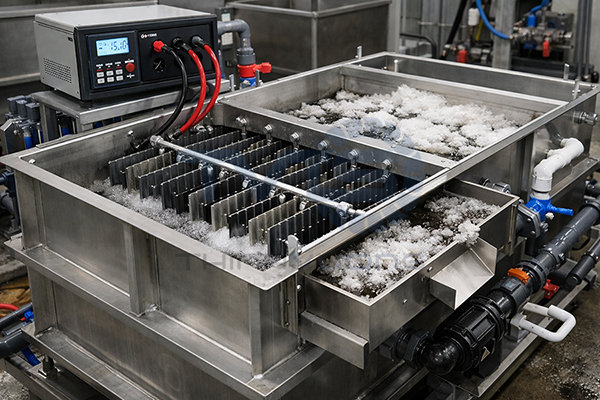
A typical ECR wastewater treatment unit consists of:
- Metal electrodes (anode and cathode – typically iron or aluminum)
- DC power supply (rectifier)
- Electrochemical reaction chamber
- Floc separation system (flotation or sedimentation)
When current passes through the system, the electrodes dissolve and generate metal ions, while gas bubbles form simultaneously, enhancing contaminant removal efficiency.
3. Working Mechanism of ECR Technology
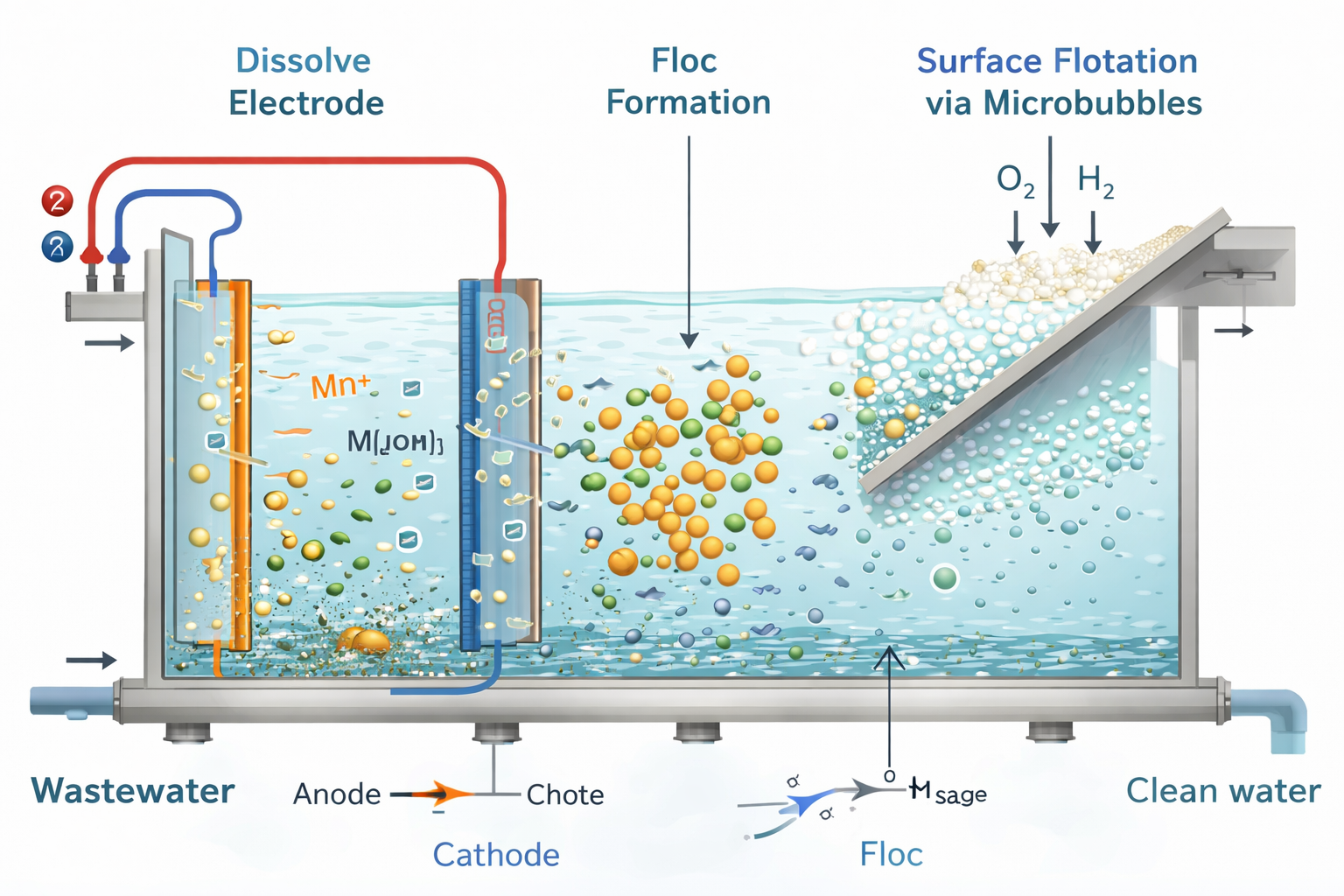
The ECR process occurs through three main stages:
3.1 Electrode Dissolution (Electrochemical Generation)
At the anode:
M(s)→Mn++ne−M_{(s)} → M^{n+} + ne^-
At the cathode:
4H2O+4e−→2H2+4OH−4H_2O + 4e^- → 2H_2 + 4OH^-
At higher potential, oxidation reactions may occur:
2Cl−→Cl2+2e−2Cl^- → Cl_2 + 2e^-
The generated chlorine acts as a strong oxidizing agent, helping degrade organic pollutants.
3.2 Contaminant Destabilization and Coagulation
Metal ions generated from electrodes:
- Neutralize charged particles
- Reduce electrostatic repulsion
- Destabilize colloidal contaminants
This leads to efficient coagulation without relying heavily on chemical additives.
3.3 Floc Formation and Electroflotation
- Metal hydroxides form adsorption surfaces
- Contaminants bind into flocs
- Microbubbles (H₂ and O₂) attach to flocs
- Flocs float to the surface for removal
This combined coagulation–flotation mechanism significantly improves separation efficiency.
4. Role of ECR in Wastewater Treatment Systems
ECR technology is most effective as a pre-treatment solution in advanced wastewater treatment systems.
Typical placement in treatment processes:
- Before RO / STRO membrane systems
- Before evaporation and crystallization
- In ZLD (Zero Liquid Discharge) systems
- Before DAF or physicochemical treatment
Key performance outcomes:
- COD reduction: 20–60%
- Heavy metal removal (Cu, Ni, Cr, Zn)
- Oil and grease reduction
- Suspended solids removal
- Color and odor control
By stabilizing influent quality, ECR helps:
- Reduce membrane fouling
- Minimize scaling in evaporators
- Lower chemical consumption and OPEX
5. Importance of ECR Technology in Industrial Applications
ECR technology plays a strategic role in modern wastewater treatment systems due to:
✔ Reduced chemical dependency
✔ Lower sludge generation compared to conventional methods
✔ High adaptability to variable wastewater composition
✔ Compatibility with automation (PLC/SCADA systems)
✔ Strong performance with high COD, TDS, and heavy metals
Industries where ECR is highly effective:
- Electroplating and metal finishing
- Electronics manufacturing
- Chemical processing
- Waste-to-energy plants
- Hazardous waste treatment facilities
6. Role of ECR in ZLD Systems
In Zero Liquid Discharge (ZLD) systems, ECR acts as a critical pre-treatment step.
It prepares wastewater before:
- Membrane filtration
- Evaporation systems (HPVE, MVR)
- Crystallization processes
By reducing contaminant load early, ECR:
- Improves system efficiency
- Extends equipment lifespan
- Reduces total treatment cost
7. Conclusion
Electro Contaminant Removal (ECR) is not just an alternative treatment method—it is a core enabling technology for handling complex industrial wastewater.
When integrated properly, ECR:
✅ Enhances overall treatment performance
✅ Reduces operational cost
✅ Protects downstream systems
✅ Supports sustainable wastewater management
✅ As industries move toward reuse and ZLD, ECR technology will become an essential component in advanced wastewater treatment strategies.

Some of the projects we have been and are doing