Nội dung
1. ADVANCED OXIDATION PROCESSES
Advanced Oxidation Processes (AOPs) use chemical reactions involving hydroxyl radicals (OH·) to remove organic and inorganic constituents from water and wastewater through oxidation.
Hydroxyl radicals act as highly reactive oxidizing agents in water treatment. Their oxidation potential ranges from 2.8 V at pH 0 to 1.95 V at pH 14, relative to the Saturated Calomel Electrode (SCE). Researchers commonly use the SCE as a reference electrode (Tchobanoglous G. et al., 2003).
In wastewater treatment applications, AOPs frequently use strong oxidizing agents such as ozone (O₃) and hydrogen peroxide (H₂O₂). These processes often combine these agents with ultraviolet (UV) radiation.
Hydroxyl radicals react non-selectively with pollutants. Once formed, they rapidly and effectively break down pollutants and convert them into smaller inorganic molecules.
AOPs generate hydroxyl radicals using one or more primary oxidizing agents, such as ozone, hydrogen peroxide, or oxygen. They can also use energy sources, such as ultraviolet light, or catalysts, such as titanium dioxide (TiO₂).
2. PRINCIPLES AND MECHANISMS OF ADVANCED OXIDATION PROCESSES IN WASTEWATER TREATMENT
The oxidation of organic compounds (RH or PhX), organometallic compounds, and inorganic substances can occur via the following three mechanisms:
i) Abstraction of a hydrogen atom (dehydrogenation):
OH● + RH → R● + H2O (1.1)
ii) Addition reaction at an unsaturated bond (hydroxylation):
OH● + PhX → HOPhX● (1.2)
iii) Electron transfer (redox reaction):
OH● + RH → RH+● + OH− (1.3)
OH● + RX → RXOH● → ROH+● + X− (1.4)
Among these reactions, the addition of hydroxyl radicals to aromatic rings occurs at rate constants ranging from 10⁸ to 10¹⁰ L·mol⁻¹·s⁻¹. Aromatic rings commonly occur in the molecular structures of persistent organic pollutants (POPs).
As a result, Advanced Oxidation Processes (AOPs) offer highly effective methods for treating persistent organic pollutants (POPs) in water. These pollutants resist biological degradation or cannot undergo biodegradation.
AOPs break down these pollutants into CO₂, H₂O, and smaller, less toxic organic compounds. Microorganisms can then biodegrade these smaller compounds more easily.
(Le Thanh Son, Tran Manh Hai et al., 2017)
3. FACTORS INFLUENCING ADVANCED OXIDATION PROCESSES
Research also indicates that during the application of Advanced Oxidation Processes (AOPs) for wastewater treatment, hydroxyl radicals (OH·) or sulfate radicals (SO4·⁻) are generated in sufficient quantities to eliminate recalcitrant organic compounds, organic pollutants, and certain inorganic contaminants. Furthermore, these processes can enhance the biodegradability of wastewater, serving as a pre-treatment step prior to subsequent biological treatment. (Yang Deng & Renzun Zhao, 2015)
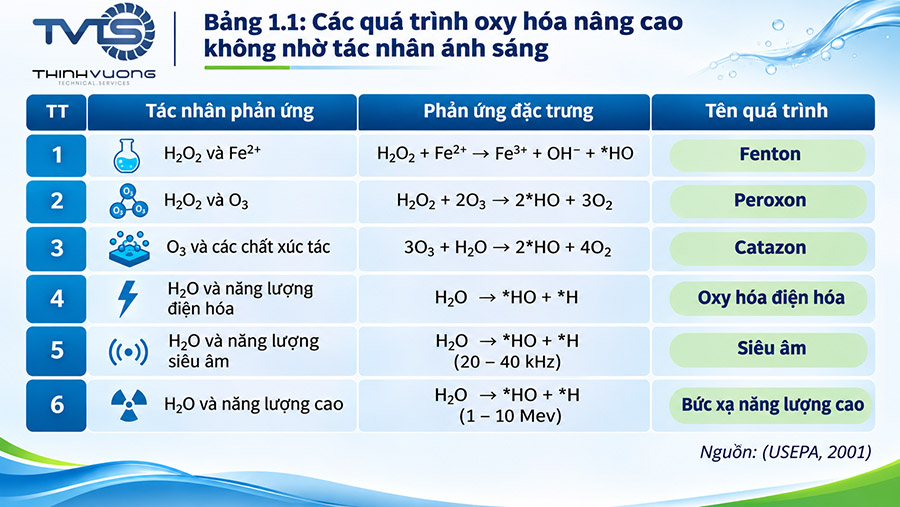
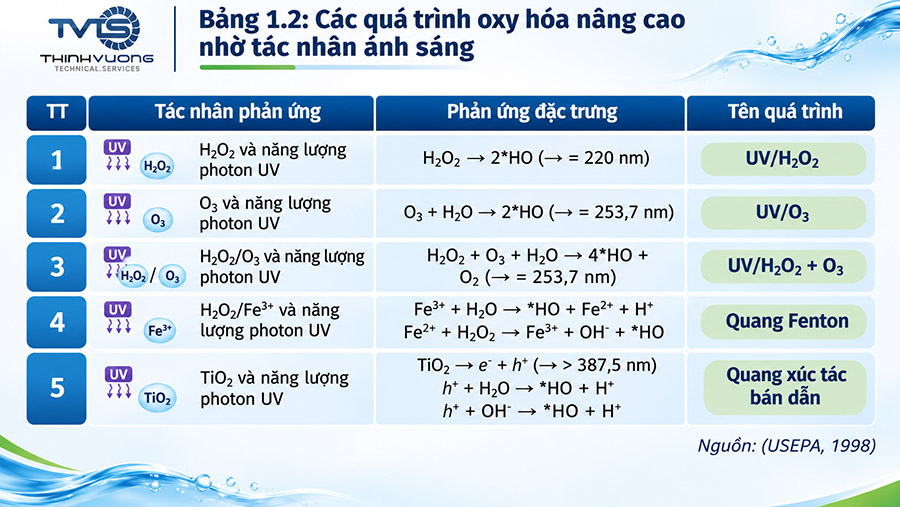
According to the United States Environmental Protection Agency (USEPA), Advanced Oxidation Processes can be categorized into two groups based on whether or not ultraviolet (UV) radiation is utilized:
3.1 Non-photochemical Advanced Oxidation Processes
Non-photochemical Advanced Oxidation Processes are those that do not rely on ultraviolet (UV) radiation energy during the reaction; these are listed in the table below:
3.2 Light-driven advanced oxidation processes
Light-driven advanced oxidation processes are those that utilize ultraviolet (UV) radiant energy; these processes are presented in the table below:
3.3 Fenton-based Advanced Oxidation
Among the metals capable of activating H2O2 to generate hydroxyl radicals in water, iron is the most frequently used. In the so-called Fenton process, H2O2 reacts with Fe2+ to produce highly reactive species. The fundamental mechanism of the Fenton process primarily involves the following reaction:
Fe2+ + H2O2 → Fe3+ + OH● + OH- (1.5)
The OH● radical is generated via equation (1.5) through electron transfer. However, reaction (1.5) occurs only in an acidic environment (pH 2–4), and the Fenton process is highly dependent on pH, the initial concentrations of the reactants, and the presence of other inorganic ions. Furthermore, the optimal molar ratio of iron ions to hydrogen peroxide (H2O2) must be determined experimentally to avoid inefficient chemical usage and waste. (Yang Deng & Renzun Zhao, 2015)
When applied under appropriately controlled conditions, advanced oxidation processes (AOPs) can reduce pollutant concentrations to very low levels, thereby significantly decreasing both chemical oxygen demand (COD) and total organic carbon (TOC). Consequently, advanced oxidation has become a preferred and widely adopted solution in contemporary wastewater treatment processes.
Source: Nguyen Van Hieu. (2021). Treatment of highly toxic wastewater using advanced oxidation processes combined with reverse osmosis membrane technology: A case study at the waste-to-energy plant in Bac Ninh province.