🧪 SELECTING MATERIALS FOR THE EVAPORATOR IN INDUSTRIAL PROCESS APPLICATIONS
Nội dung
⚙️ 1️⃣ The Role of Material Selection in Evaporator Design
When engineers design and operate an evaporation system, the construction material directly determines equipment durability, corrosion resistance, and long-term operational stability.
Unlike conventional wastewater treatment equipment, evaporators operate under:
Elevated temperatures (40–80°C),
Increasing salt concentration during concentration cycles,
High levels of aggressive ions such as Cl⁻, SO₄²⁻, F⁻, and heavy metals.
Therefore, engineers must choose the right evaporation material based on the solution at its final concentrated condition — not just the initial influent composition. At maximum concentration, corrosive ions reach their highest levels and significantly increase corrosion risks.
Selecting suitable evaporator material at this stage protects the system from premature failure and costly downtime.
🧩 2️⃣ Common Materials Used in Evaporation Systems
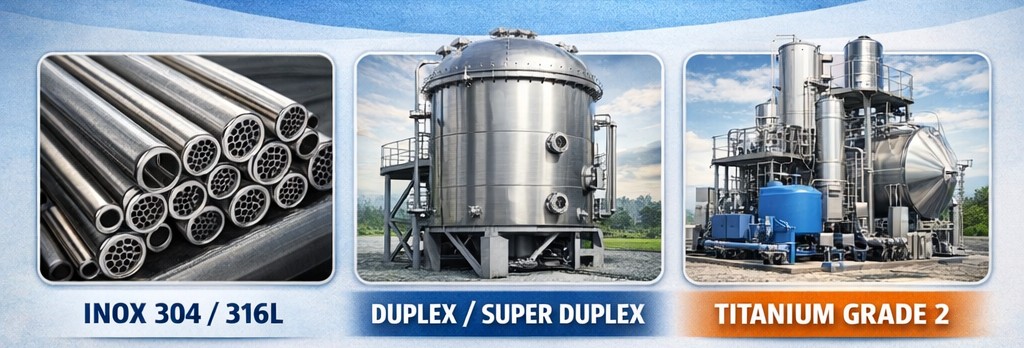
2.1 Stainless Steel 304 / 316 / 316L – Cost-Effective for Standard Applications
Stainless steel 304, 316, and 316L remain widely used in evaporator fabrication because they offer:
Easy fabrication and welding,
Good heat resistance,
Reasonable capital investment cost.
For low-to-moderate corrosive wastewater, stainless steel provides:
High heat transfer efficiency,
Easy cleaning and maintenance,
Smooth surfaces that reduce scaling.
However:
When chloride concentration exceeds 2,000 mg/L, especially in deep evaporation or ZLD systems, stainless steel — particularly SS304 — becomes vulnerable to:
Pitting corrosion,
Stress corrosion cracking.
Engineers should therefore use stainless steel only for:
Primary evaporation stages,
Low-salinity, low-COD solutions,
Applications that do not require high concentration ratios.
2.2 Duplex & Super Duplex – Reliable for Highly Corrosive Conditions
When wastewater contains high chloride, sulfate, or heavy metal concentrations, high-alloy materials such as Duplex (2205) and Super Duplex (2507) provide superior protection.
Key advantages:
Significantly higher chloride corrosion resistance than conventional stainless steel,
Strong resistance to stress corrosion cracking,
High mechanical strength under elevated temperature and pressure,
Excellent performance in forced circulation evaporation systems,
Stable operation in harsh ZLD environments.
Typical applications:
Evaporation–crystallization systems,
Electroplating wastewater treatment,
Chemical wastewater,
Concentration of inorganic salt solutions.
Limitations:
1.8–2.2 times higher cost than stainless steel,
Requires advanced welding and fabrication techniques.
Despite the higher CAPEX, Duplex and Super Duplex typically deliver 3–5 times longer service life, making them ideal for heavy industrial plants where reliability is critical.
2.3 Titanium – Premium Solution for Extremely High Chloride Environments
Titanium forms a stable and self-healing oxide layer that provides exceptional corrosion resistance.
Titanium offers:
Near immunity to chloride attack,
Long-term stability at Cl⁻ > 100,000 mg/L,
Lower density, which reduces structural load and improves heat transfer efficiency.
Typical applications:
Seawater evaporation systems,
High-salinity industrial brine,
Landfill leachate treatment,
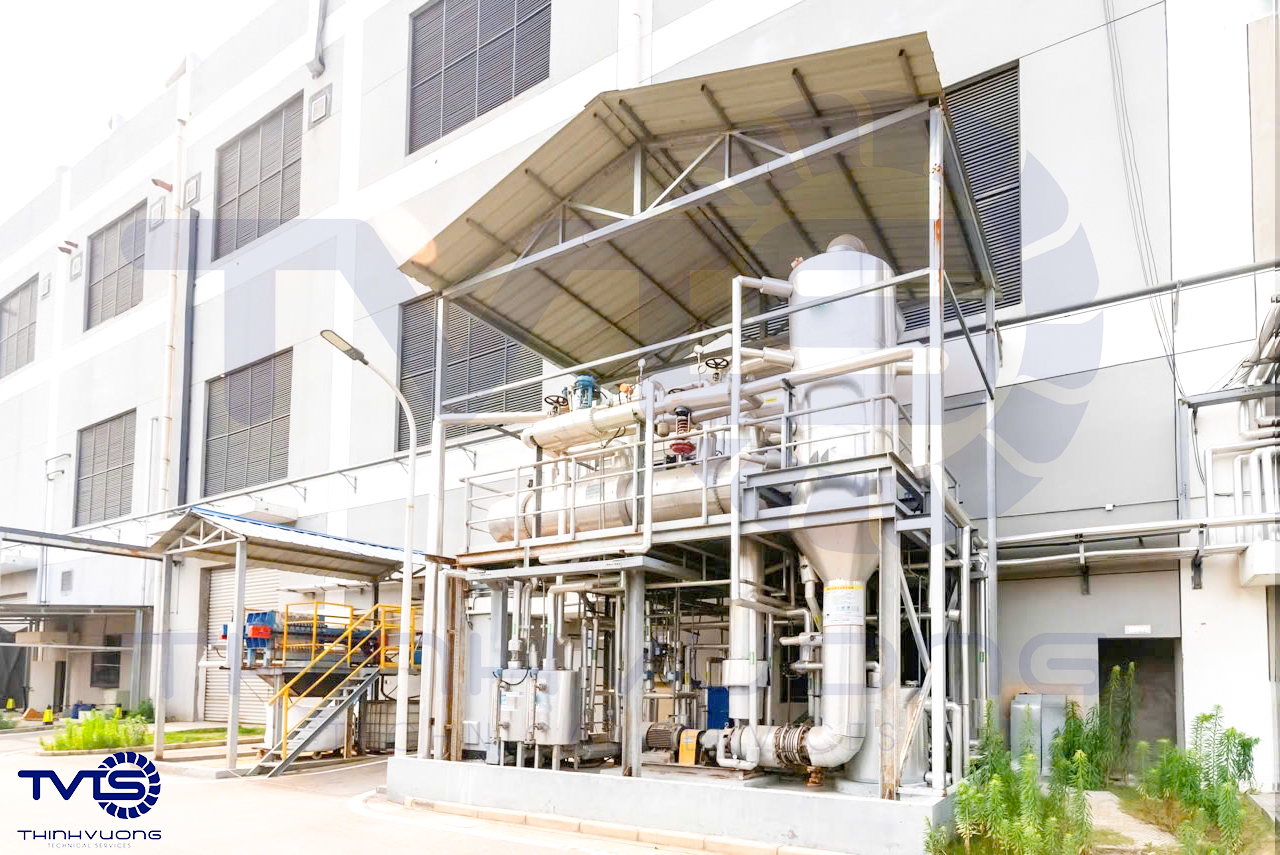
HPVE and MVR systems in hazardous wastewater ZLD plants.
Important considerations:
Not suitable for environments with pH < 4,
Not recommended when fluoride ions (F⁻) are present,
Requires high-precision welding and strict thermal control,
Higher fabrication cost — generally selected for systems requiring >15 years of service life.
🌡 3️⃣ Comparative Overview of Evaporator Materials
| Material | Chloride Resistance | Temperature Resistance | Investment Cost | Recommended Applications |
|---|---|---|---|---|
| SS304 / SS316L | Moderate (≤2,000 mg/L) | Up to 80°C | ★☆☆☆ | Primary evaporation, low-strength wastewater |
| Duplex / Super Duplex | Very High (≤50,000 mg/L) | Up to 100°C | ★★★☆ | Crystallization, electroplating wastewater, ZLD |
| Titanium | Excellent (>100,000 mg/L) | 80–90°C | ★★★★ | HPVE systems, landfill leachate, seawater evaporation |
🧠 4️⃣ TVTS Expert Recommendation
“Choose the right evaporation material today to protect your long-term investment.”
TVTS recommends:
Always evaluate wastewater characteristics at the final concentration stage before selecting materials.
Prioritize Titanium or Duplex for deep evaporation, ZLD systems, or high-chloride wastewater.
Use SS316L for light wastewater or food-processing applications where salinity remains moderate.
Consult experienced engineers to optimize both CAPEX and OPEX before finalizing material selection.
Properly selecting suitable evaporator material not only extends equipment lifespan but also stabilizes operational performance and reduces maintenance cost.