Nội dung
- 🌊 1️⃣. GENERAL INTRODUCTION TO THE ELECTROPLATING WASTEWATER EVAPORATION TECHNOLOGY PROJECT
- 💧 2️⃣. INFLUENT WASTEWATER CHARACTERISTICS
- 🔬 3️⃣. HPVE TECHNOLOGY COMBINED WITH STRO MEMBRANE SOLUTION
- ⚙️ 4️⃣. PERFORMANCE & OPERATING COST
- 🧩 5️⃣. RESULTS AND PRACTICAL APPLICATION
- 🌱 6️⃣. ADVANTAGES OF THE HPVE + STRO SOLUTION
- 🏁 7️⃣. CONCLUSION
🌊 1️⃣. GENERAL INTRODUCTION TO THE ELECTROPLATING WASTEWATER EVAPORATION TECHNOLOGY PROJECT
In the electroplating and metal processing industry, wastewater contains very high concentrations of salts, heavy metals, and COD. These characteristics often exceed the treatment capacity of conventional biological or physicochemical processes.
To comply with the latest discharge regulation QCVN 40:2011/BTNMT – Column B, reduce operating costs, and move toward a Zero Liquid Discharge (ZLD) model, TVTS researched and implemented Heat Pump Vacuum Evaporation (HPVE) technology combined with STRO membrane filtration at an electroplating plant with a capacity of 100 m³/day.
💧 2️⃣. INFLUENT WASTEWATER CHARACTERISTICS
2.1 Flow Rate
Wastewater flow rate: 0.1 m³/hour (~2 m³/day)
Operating time: 20 hours/day
Planned expansion: 0.3 m³/hour (~6 m³/day) in the next phase
2.2 Influent Wastewater Composition
| No. | Parameter | Unit | Actual Value | System Design Value |
|---|---|---|---|---|
| 1 | pH | – | 9.5 | 7.5 – 8.5 |
| 2 | Color | Pt-Co | 89 | < 100 |
| 3 | TSS | mg/L | 172 | < 200 |
| 4 | BOD | mg/L | 337 | < 500 |
| 5 | COD | mg/L | 16,756 | < 20,000 |
| 6 | Ammonia | mg/L | 89.6 | < 100 |
| 7 | Total Nitrogen | mg/L | 337 | < 400 |
| 8 | Phosphorus | mg/L | 43.3 | < 50 |
| 9 | Oil & Grease | mg/L | 151 | < 200 |
| 10 | TDS | mg/L | <10,000 | <10,000 |
2.3 Effluent Requirements (QCVN 40:2011 – Column B)
| No. | Parameter | Unit | Permissible Limit |
|---|---|---|---|
| 1 | pH | – | 5.5 – 9.0 |
| 2 | Color | Pt-Co | 150 |
| 3 | TSS | mg/L | 100 |
| 4 | BOD | mg/L | 50 |
| 5 | COD | mg/L | 150 |
| 6 | Ammonia | mg/L | 10 |
| 7 | Total Nitrogen | mg/L | 40 |
| 8 | Phosphorus | mg/L | 6 |
| 9 | Oil & Grease | mg/L | 10 |
🔬 3️⃣. HPVE TECHNOLOGY COMBINED WITH STRO MEMBRANE SOLUTION
3.1 Operating Principle
When the level sensor in the feed tank detects a full condition, the system automatically starts the vacuum pump and creates a pressure of approximately 33 mbar inside the evaporation chamber.
Under this condition, wastewater boils at a very low temperature (30–40°C), which reduces energy consumption and limits organic compound degradation.
During the electroplating wastewater evaporation process:
The compressor compresses refrigerant gas to 60–70°C at 16–20 bar,
The hot refrigerant transfers heat to the wastewater inside the evaporation chamber,
The generated vapor flows to the condenser and forms clean condensate water.
The system stores condensate in the condensate tank and then circulates it through the STRO RO membrane to ensure reuse water quality.
Average power consumption: 140–150 W per liter of influent wastewater.
3.2 Concentration Performance
Concentration factor: 8–10 times
Clean water recovery rate: 95%
Evaporation temperature: 35–40°C
Operating vacuum: 33 mbar
No cooling tower or auxiliary boiler required
When the wastewater reaches the designed concentration level, the discharge valve opens automatically and transfers the concentrate to the hazardous waste storage tank. The condensate passes through the STRO membrane system and is reused for cooling towers or metal surface rinsing.
⚙️ 4️⃣. PERFORMANCE & OPERATING COST
| Parameter | HPVE 100 L/h | HPVE 300 L/h | HPVE + RO |
|---|---|---|---|
| Power Consumption | 16 kWh/20h | 48 kWh/20h | 30 kWh/20h |
| Electricity Cost (VND/m³) | 320,000 | 320,000 | 200,000 |
| Evaporation Maintenance Cost (VND/m³) | 19,000 | 11,000 | 26,000 |
| Concentrate Disposal Cost | 150,000 | 150,000 | 150,000 |
| Total OPEX | 523,000 VND/m³ | 515,000 VND/m³ | 510,000 VND/m³ |
⚡ The system reduces treatment costs by approximately 70% compared to conventional physicochemical treatment (typically 1.6–1.8 million VND/m³).
Payback period (ROI): ~1.3 years.
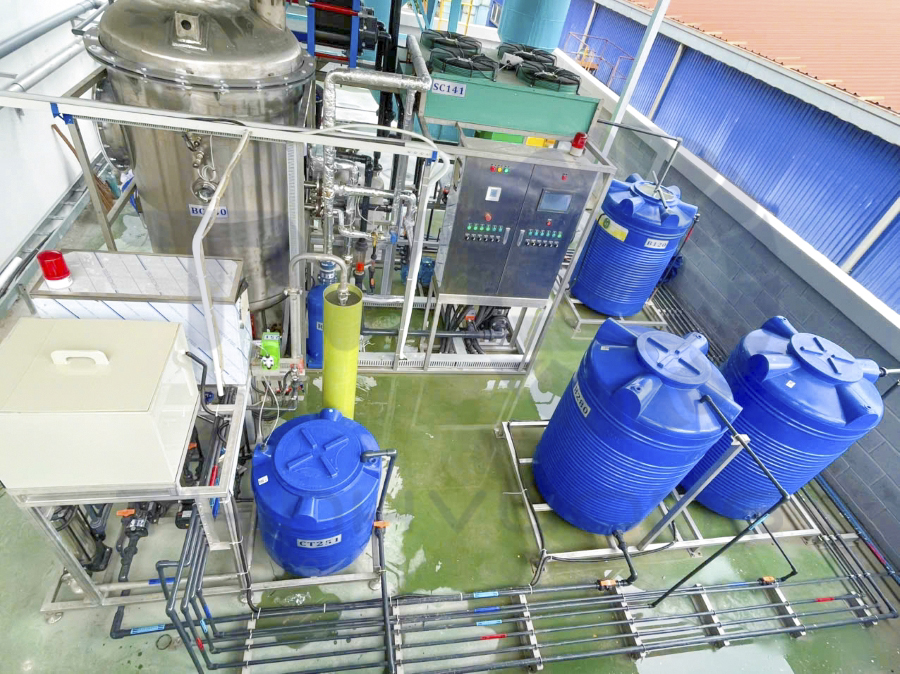
🧩 5️⃣. RESULTS AND PRACTICAL APPLICATION
Water evaporation and separation efficiency >95%
Treated water can be reused internally
Concentrate volume decreases by >90%, significantly reducing hazardous waste disposal costs
🌱 6️⃣. ADVANTAGES OF THE HPVE + STRO SOLUTION
No steam, boiler, or cooling tower required
Lowest electricity consumption among concentration systems
PLC–SCADA automation, easy operation, simple maintenance
Titanium / Duplex materials resistant to Cl⁻ and Ni²⁺ corrosion
Complies with QCVN 40:2011 standards and supplies water to cooling towers
Supports Zero Liquid Discharge (ZLD) – no wastewater discharge to the environment
🏁 7️⃣. CONCLUSION
The successful application of electroplating wastewater evaporation technology using HPVE combined with STRO membrane filtration demonstrates high efficiency:
Reduces operating costs by more than 70%
Recovers 95% clean water
Reduces hazardous solid waste by >90%
Meets environmental discharge standards and supports circular economy and ZLD strategies
TVTS – Thinh Vuong Technical Services JSC
Pioneer in designing and manufacturing evaporation, crystallization, and ZLD systems in Vietnam.