In modern industries, wastewater is no longer considered waste. With advanced treatment technologies, factories can recover, recycle, and reuse water — reducing both costs and environmental impact.
Below are the five most effective wastewater reuse technologies that industrial plants are adopting worldwide.
As shared in the article “Reuse of wastewater”. Reverse Osmosis membrane technology (RO) is ranked the best in the current wastewater treatment and circulation application.
Nội dung
- 1. Reverse Osmosis membrane RO in the wastewater reuse process
- 2. Ultrafiltration (UF) membrane
- 3. Nanofiltration (NF) membrane
- 4. Membrane Bioreactor (MBR)
- 5. Pretreatment process
- 6. Evaporation and Crystallization (ZLD Technology)
- 7. Ion exchange technology
- 8. Electrodeionization (EDI)
- 9. Advanced Oxidation Processes (AOP)
- 10. Choosing the Right Technology for Your Factory
- Partner with TVTS – Your Wastewater Reuse Specialist
1. Reverse Osmosis membrane RO in the wastewater reuse process
RO uses semi-permeable membranes to remove dissolved salts, organics, and heavy metals from wastewater.
Double-pass RO (two-stage RO) enhances purity and recovery efficiency.
1.1 Advantages:
High removal efficiency for TDS, COD, and hardness.
Produces water close to demineralized quality.
Suitable as a polishing step after MBR.
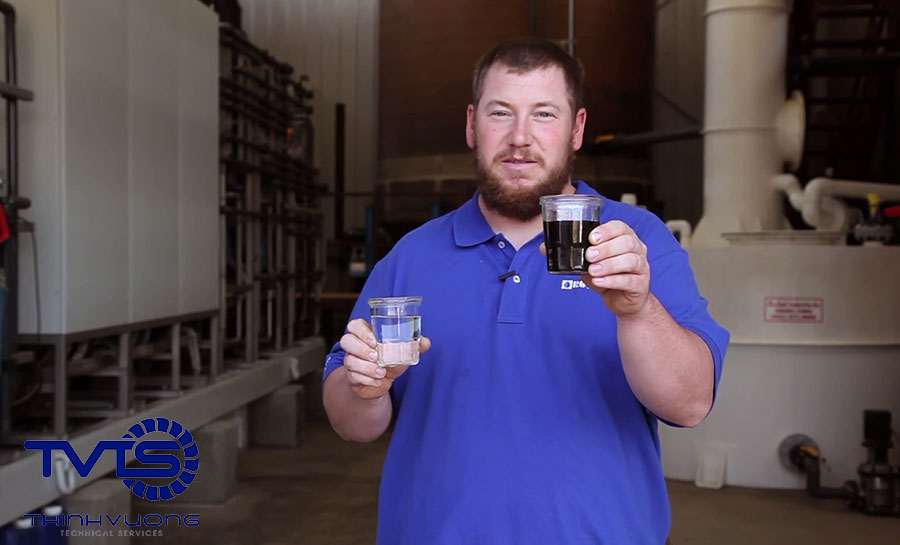
1.2 TVTS uses TSRO membrane for industrial wastewater treatment to meet reuse standards
TSRO membrane module in the form of a buffer tube. It is an improvement from the module with a conventional spiral structure and a perfect combination with the open channel design. The TSRO module has the following advantages.
1.3.1 Advantages of TSRO membrane module
- The treated water meets the reuse standards.
- The ability to recover clean water is up to 95%.
- The treatment process completely removes color.
- No chemicals are used / Very little chemicals are used for the pre-treatment process.
- The membrane structure minimizes clogging.
- The technology has been proven effective worldwide.
- The total investment and operating costs are lower than traditional treatment systems with the same flow rate.
- The life of the membrane system is high.
- The treatment system is compact, flexible in installation location, does not require too large an area.
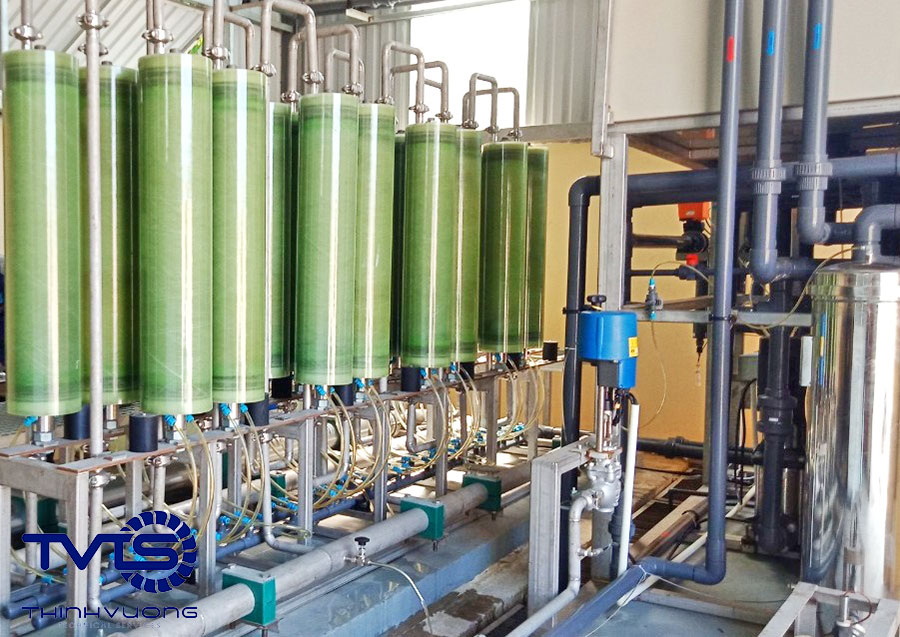
TSRO module is suitable for wastewater treatment for reuse needs. Some industries have effectively applied TSRO membrane water treatment systems.
1.3.2 Application of TSRO membrane module
- Reuse of wastewater from the textile and dyeing industry.
- Reuse of wastewater from the electroplating industry.
- Reuse of wastewater from the leather industry.
- Reuse of wastewater from the food and pharmaceutical industries.
- Reuse of wastewater from the electronic component manufacturing industry (hazardous wastewater).
- Waste-to-energy industry, waste treatment areas (leachate treatment).
- Reuse of industrial wastewater, industrial parks.
- Reuse of domestic wastewater, residential areas, urban areas.
- Reuse of agricultural and fishery wastewater. Livestock wastewater.
Besides RO membrane, some other membrane technologies are also widely applied in the reuse wastewater treatment process such as: UF, MF, NF membrane or MBR biological membrane (rarely used but used in the wastewater pretreatment process).
2. Ultrafiltration (UF) membrane
2.1 Description about UF membrane (also known as ultrafiltration) is often used for purposes such as:
- Production of drinking water from surface water and groundwater.
- Production of water supply for the food and beverage manufacturing and processing industry.
- Some biotechnology industries.
- Treatment of wastewater with low pollution concentration.
UF membrane is highly effective in treating less polluted input water for production. And because UF membrane has large filter pore size, it is often used as a pre-filter for RO membrane system to remove suspended solids TSS, some viruses, metals… to increase RO membrane life and reduce membrane clogging during operation.
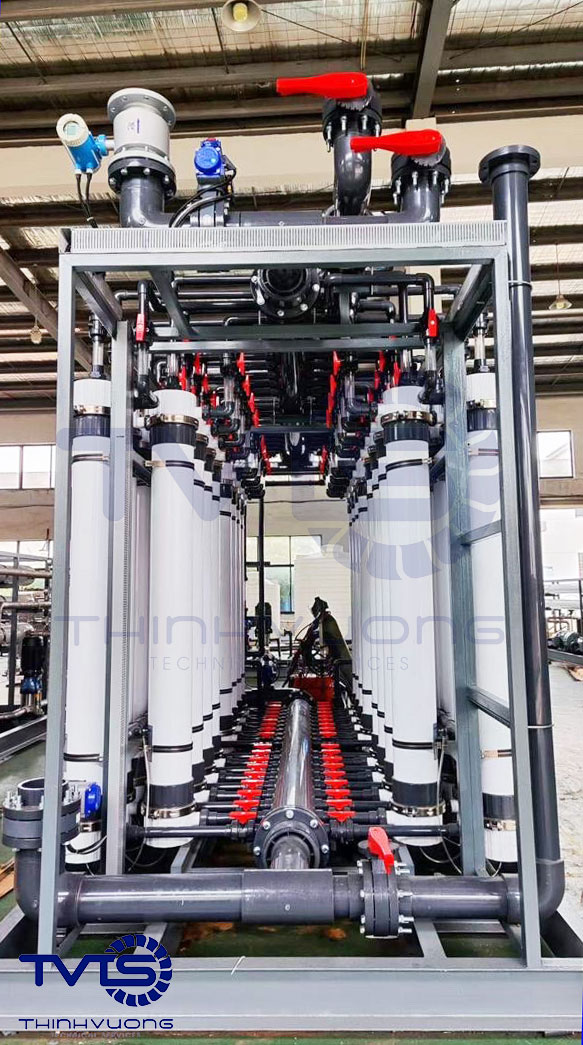
2.2 Advantages of UF membrane filter
+ UF is a mechanical filter membrane, so it will not change the properties of water too much.
+ UF has the ability to remove most of the insoluble and toxic solids in water.
+ The system is not bulky, does not require much space for installation.
+ UF membrane operation uses low pressure. Therefore, it consumes less energy, reducing operating costs.
3. Nanofiltration (NF) membrane
NF membrane is a membrane with filtering ability between RO and UF membranes. NF operates at a pressure range of 100 – 600 psi. It is often applied in fields and purposes such as:
- Fruit juice processing industry.
- Producing clean water for daily use.
- Serving the treatment of production water.
- Removing color from surface water.
- Removing hardness.

In case of wastewater treatment meeting reuse standards, it will be combined with some other treatment methods. Ensure that the input water of the NF system meets the standards of domestic water.
3.1 Advantages of Nanofiltration (NF) membrane
- Nano membrane operates at low pressure so it consumes less electricity. Saves operating costs compared to RO membrane.
- NF is a type of filter membrane with large filter holes, suitable for water with low pollution content, or as a pre-filter for RO membrane systems.
- Removes and reduces salt and dissolved substances in brackish water.
- Reduces heavy metal indexes, sulfate, nitrate, nitrite, color, etc.
- Highly effective when used to soften water.
3.2 Disadvantages of NF membrane
- High cost. Requires high water quality for the input of the filtration system.
- Low power consumption but still higher than UF membrane.
- Water needs to be dechlorinated before entering the NF filtration system. Because of the membrane’s sensitivity to chlorine.
4. Membrane Bioreactor (MBR)
MBR combines biological treatment and membrane filtration in one compact system. It uses microfiltration or ultrafiltration membranes to separate treated water from sludge.
Advantages:
Produces high-quality effluent suitable for reuse (cooling, cleaning, irrigation).
Compact design, smaller footprint.
Stable operation even with variable influent quality.
Applications:
Food & Beverage, Textile, Electronics, Pharmaceutical plants.

5. Pretreatment process
Pretreatment is the preliminary wastewater treatment process. Using physical, chemical, biological methods to reduce the concentration of substances in wastewater to an acceptable level. Reaching the input limit for the main wastewater treatment technologies in the next wastewater treatment process.
Pretreatment can include the following methods:
- Physicochemical treatment.
- Coagulation, flocculation.
- Ozone.
- Chemical and microbiological methods.
6. Evaporation and Crystallization (ZLD Technology)
Evaporators (such as MVR, HPVE, or Forced Circulation types) concentrate wastewater, separating pure distillate water and solid residues.
When combined with crystallizers, they form a Zero Liquid Discharge (ZLD) system — ensuring no liquid waste is discharged.
Advantages:
Achieves 95–100% water recovery.
Reduces environmental liabilities.
Enables reuse even for complex, saline wastewater.
Applications:
Chemical, Electroplating, Power, and Pharmaceutical industries.
7. Ion exchange technology
Widely used in water treatment or ultra-pure water production. Only used in wastewater reuse processes when the output water quality requires high purity.
Usually when mentioning ion exchange technology, we immediately think of this as water treatment technology. And that is true, because of its ability to treat water with low pollution concentrations to create ultra-pure water. Therefore, ion exchange technology is rarely used in wastewater reuse treatment.
Because to treat water needed for high-tech industries, the input water is tap water. New ion exchange technology brings high efficiency. In case of using recycled wastewater to become ultra-pure water, it is possible. But the investment and operating costs are too high.

However, any water treatment technology has its own strengths. The job of technicians is to know how to apply them skillfully to get the best results.
TVTS consulted on ion exchange technology for a wastewater reuse project. The project needed to reuse wastewater in a textile dyeing factory. The third or fourth fabric wash water had a low concentration of pollutants, using ion exchange to remove hardness. The water quality after ion exchange met the standards to return to the normal fabric washing and cooking process.
8. Electrodeionization (EDI)
EDI integrates ion exchange resins and electric current to continuously remove ions without chemical regeneration.
It is often used after RO for ultra-pure or reuse-grade water.
Advantages:
Chemical-free operation.
Continuous, automated system.
Produces ultrapure water suitable for reuse in high-tech manufacturing.

9. Advanced Oxidation Processes (AOP)
AOP uses ozone, hydrogen peroxide, or UV light to break down persistent organic compounds that traditional biological systems cannot treat.
Factories often use it as a polishing step before reuse.
Advantages:
Removes color, odor, and trace pollutants.
Improves oxidation potential for safe reuse.
Ideal for high-COD industrial wastewater.
10. Choosing the Right Technology for Your Factory
Every factory’s wastewater is unique — in composition, flow, and required reuse quality.
At TVTS, our experts analyze influent data (COD, BOD, TDS, Ammonia, etc.) and design integrated systems combining the right technologies — from MBR + RO + EDI, to full ZLD setups.
Key factors we evaluate:
Wastewater characteristics
Space availability
Target reuse standard (QCVN / local regulation / process reuse)
Cost & payback

Partner with TVTS – Your Wastewater Reuse Specialist
TVTS has delivered over 100 water & wastewater projects across Vietnam and ASEAN.
We provide turnkey EPC services, from pilot testing to commissioning.