Nội dung
- What Is Hazardous Wastewater? 12 Common Groups of Hazardous Wastewater & Industrial Sectors That Generate Hazardous Effluents
- 1. What is hazardous wastewater?
- 2. Classification table of 12 common groups of hazardous wastewater in Vietnam
- 3. Rapid identification of hazardous wastewater by industrial sector
- 4. Selected case studies: Industrial parks, electronics, electroplating, solvent waste
- 5. Issues arising from improper classification of hazardous wastewater
- 6. Conclusion what hazardous wastewater is
What Is Hazardous Wastewater? 12 Common Groups of Hazardous Wastewater & Industrial Sectors That Generate Hazardous Effluents
Hazardous wastewater is a type of wastewater that contains components capable of causing toxicity, corrosion, infection, flammability, explosion, or long-term impacts on human health and the environment. Understanding what hazardous wastewater is, where it originates, and how to classify it properly is an essential step that helps enterprises manage risks, comply with regulations, and select the right treatment technologies.
1. What is hazardous wastewater?
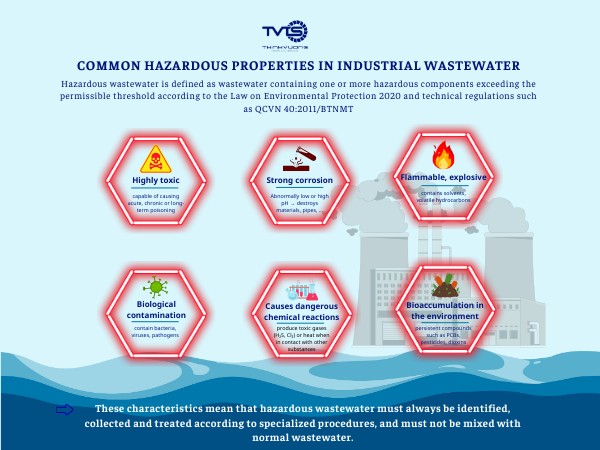
Hazardous wastewater is defined as wastewater that contains one or more hazardous components exceeding allowable limits according to the Law on Environmental Protection 2020 and technical regulations such as QCVN 40:2011/BTNMT. These components may include heavy metals, organic solvents, mineral oils and greases, flammable chemicals, acutely toxic compounds, pathogens, or persistent substances that are difficult to degrade.
Common hazardous characteristics of wastewater
High toxicity: may cause acute toxicity, chronic poisoning, or long-term health impacts.
Strong corrosiveness: abnormally high or low pH → damages materials, pipelines, and equipment.
Flammable or explosive: contains solvents or volatile hydrocarbons.
Biological contamination: contains bacteria, viruses, or pathogenic microorganisms.
Hazardous chemical reactivity: generates toxic gases (H₂S, Cl₂) or heat when mixed with incompatible substances.
Bioaccumulation in the environment: persistent compounds such as PCBs, pesticides, and dioxins.
➡ These properties require hazardous wastewater to be properly identified, segregated, collected, and treated through a specialized process. It must never be mixed with conventional wastewater streams.
2. Classification table of 12 common groups of hazardous wastewater in Vietnam
According to hazardous waste classification guidelines (based on the hazardous waste code list), hazardous wastewater from industrial activities can be divided into the 12 groups below.
| Group | Description | Typical hazardous constituents |
|---|---|---|
| 1. Wastewater containing heavy metals | From electroplating, metallurgy, electronics | Pb, Ni, Cu, Zn, Cr6+, Cd |
| 2. Wastewater containing organic solvents | Paints, inks, chemicals, electronics manufacturing | Toluene, Xylene, MEK, IPA |
| 3. Wastewater containing mineral oils and greases | Garages, mechanical workshops, oil & gas | DO, FO, hydraulic oils |
| 4. Strong acid – strong alkali wastewater | Metal cleaning, etching | HCl, H₂SO₄, NaOH, KOH |
| 5. Cyanide-contaminated wastewater | Electroplating, gold plating | CN-, metal–cyanide complexes |
| 6. Wastewater containing phenols | Thermal power, petrochemicals | Phenol, cresol |
| 7. Pesticide-contaminated wastewater | Agriculture, chemical warehouses | Organophosphate, carbamate |
| 8. Hazardous medical wastewater | Hospitals, laboratories | Bacteria, viruses, chemical reagents |
| 9. Infectious biological wastewater | Biotechnology, veterinary facilities | Pathogens, cells, biological tissues |
| 10. Wastewater containing toxic inorganic compounds | Chemical and metallurgical industries | High ammonium, sulfides, fluorides |
| 11. Radioactive wastewater | Measuring devices, nuclear medicine | I-131, Cs-137 |
| 12. Landfill leachate | Landfills, waste-to-energy plants | High COD, high NH₄⁺, metals, salts, PFAS |
This classification helps operators and enterprises correctly identify their wastewater composition and select appropriate treatment technologies.
3. Rapid identification of hazardous wastewater by industrial sector
Identifying hazardous wastewater is not only based on laboratory analysis; it can also be assessed through the production technology and chemicals used. The following guidelines outline rapid identification for each industry.
3.1 Electroplating and metal finishing
Electroplating is one of the industries that generates the highest volume of hazardous wastewater.
Recognition signs:
Extremely low pH (2–4)
Heavy metals exceeding regulatory limits
Distinctive colors (green – yellow – brown)
Presence of cyanide or hexavalent chromium
Hazardous constituents: Ni, Cu, Zn, Pb, Cr6+, CN–
3.2 Electronics and PCB manufacturing
Electronic and PCB processes generate wastewater containing numerous solvents and surface-treatment chemicals.
Typical constituents:
Solvents: IPA, toluene, acetone
Metals: copper, tin
Anti-oxidants, PCB cleaning chemicals
3.3 Chemical – paint – ink production
These industries use large volumes of flammable solvents.
Recognition signs:
Strong solvent odor
High COD (10,000–80,000 mg/L)
High viscosity, oil film formation
Sample combustibility
3.4 Oil & gas – garages – mechanical workshops
These facilities generate wastewater mainly contaminated with mineral oils.
Recognition signs:
Thick floating oil layer
High suspended solids
Characteristic petroleum odor
High electrical conductivity
3.5 Landfills – waste-to-energy plants
Leachate is considered one of the most hazardous wastewater types.
Characteristics:
Extremely high COD (> 20,000 mg/L)
Very high ammonium
Dark color – strong decomposed organic odor
High dissolved salts (high TDS)

4. Selected case studies: Industrial parks, electronics, electroplating, solvent waste
4.1 Hazardous liquid waste treatment facility
A hazardous liquid waste treatment plant in Bac Ninh collects solvent waste, electroplating waste, and chemical waste from multiple factories in surrounding areas. The influent wastewater is a mixed stream with high variability from day to day.
Analytical results showed:
COD ranging from 5,000 – 25,000 mg/L
Acute toxicity due to heavy metals
Biological treatment not feasible
Required treatment approach: oxidation – coagulation – RO membrane – evaporation – activated carbon.

4.2 Metal processing and coating plant
A former metal processing and coating plant in Binh Duong generated wastewater containing:
IPA solvent
Strong alkalis
Copper salts
Oxidizing agents
Acids
This wastewater required strict segregation of different streams to prevent dangerous reactions (e.g., acid + chlorite → Cl₂ gas release).

5. Issues arising from improper classification of hazardous wastewater
Improper classification of hazardous wastewater leads to multiple technical and legal risks.
5.1 Dangerous chemical reactions
Mixing incompatible streams may cause:
Release of toxic gases: H₂S, NH₃, Cl₂, HCN
Exothermic reactions → explosion hazards
Foam generation → tank overflow → environmental incidents
This is common in electroplating and chemical factories.
5.2 Reduced treatment efficiency and increased costs
Hazardous wastewater containing solvents, metals, or high salinity can cause:
RO membrane fouling
Overloading of biological systems
Chemical consumption increasing 2–5 times
Significant rise in OPEX
5.3 Legal non-compliance risks
Enterprises may face:
Administrative penalties (100–1,000 million VND)
Suspension of operations
Criminal liability for major environmental incidents
5.4 Long-term environmental impacts
Hazardous wastewater can:
Contaminate groundwater
Bioaccumulate in soil
Harm ecosystems and public health
6. Conclusion what hazardous wastewater is
Understanding what hazardous wastewater is, how to classify it, and how to recognize it across industrial sectors is only the first step. To achieve effective treatment in real applications, enterprises must deepen their knowledge of treatment processes, wastewater characteristics, and the technologies currently used in Vietnam.
The upcoming articles in this series will explore these aspects in detail:
👉 The full treatment process for hazardous wastewater according to QCVN 40, from pre-treatment to advanced treatment.
👉 Comparison of 7 common hazardous wastewater treatment technologies to help select the most appropriate method for each industry.
👉 Treatment costs and influencing factors to help enterprises estimate and optimize system operation.
👉 Common issues in hazardous and hard-to-treat wastewater and practical troubleshooting solutions.
👉 Industry-specific treatment approaches: electroplating, electronics, chemicals, landfill leachate, solvents.
👉 Advanced hazardous wastewater treatment systems for waste-to-energy plants and centralized hazardous waste facilities (TVTS).
Enterprises may also refer to technical documents issued by the Ministry of Natural Resources and Environment, as well as international standards such as the EPA (USA) or the EU Industrial Emissions Directive for updated global practices in hazardous wastewater management.
Overall, managing hazardous wastewater is a continuous process requiring foundational knowledge, practical experience, and deep understanding of technology. This series aims to support enterprises step by step—from concepts and classification to technology selection and cost optimization—to build treatment systems that are effective, safe, and aligned with sustainable industrial development in Vietnam.